

We're an award-winning Product Design & Development agency specializing in web, mobile & enterprise software solutions.
Sally
Transforming a complex SPV platform into an intuitive, white-labeled experience that balances power with simplicity.


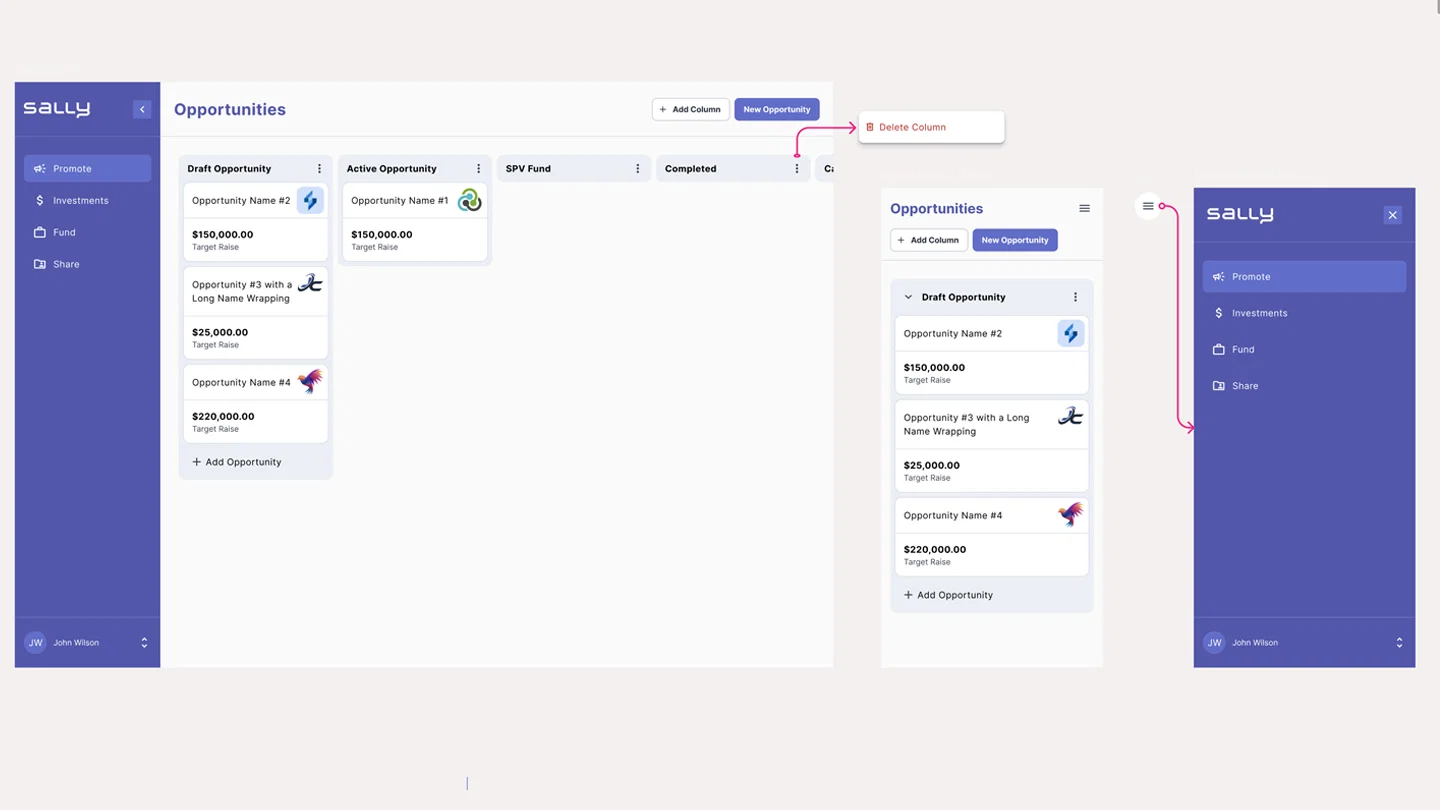
10,000 SPVs. $12 billion in assets. One interface holding it all back.
Sally had built an all-in-one platform for managing Special Purpose Vehicles that processed over 10,000 SPVs, administered more than $12 billion in assets, and onboarded 235,000 investors. The technology was there. The expertise was there. Twenty years of experience in structured vehicle management was baked into every feature.
But the interface told a different story. The platform's power was hidden behind an outdated design that confused new users and frustrated experienced ones. Complex financial workflows felt more complicated than they needed to be. White-labeling options, one of Sally's key differentiators, offered so much flexibility that customers could accidentally break their own experience with mismatched fonts, inaccessible color combinations, and layouts that fell apart on mobile.
Sally needed a UX partner who could understand the intricate world of SPV administration and translate that complexity into clarity.
The power paradox
Sally had built a platform that could do almost anything, but that flexibility had become a liability.
The platform comprised nine interconnected modules (Promote, Fund, Share, Manage, Comply, Report, Analyze, Trade, and Startup), each with its own workflows, customization options, and edge cases. The Fund module alone handled entity creation, bank account setup, document generation, e-signatures, background checks, KYC/AML compliance, and investment reconciliation. This was the heart of what customers paid for, but the interface made it feel overwhelming.
Then there was white-labeling. Sally's competitors offered white-labeled investor portals. Sally offered white-labeled everything. The entire platform could be branded with a customer's colors, fonts, logos, and custom URLs. It was a genuine differentiator. But users could select fonts that broke layouts, choose color combinations that failed accessibility standards, and create experiences that looked nothing like the polished platform they had signed up for.
The previous development team had built for power without building for protection. The UX felt like a collection of features rather than a cohesive product. Mobile responsiveness was inconsistent. Complex data tables collapsed on smaller screens. And new users faced a steep learning curve with little guidance.
Learning the language of SPVs
We started with a deep-dive discovery session where Sally's CEO walked us through every corner of the platform. This four-hour immersion took us into the world of syndicated investments, Reg D compliance, 506(c) filings, and the hundred small decisions that go into closing a deal.
"I've had this concept of the Share module for 10 years. I gave it to some developers 15 years ago, and it was months of them thinking and drawing and presenting it to me. I'm like, 'that is so bad.' For Singlemind to say it took 20 minutes… the difference between that and my prior experiences is massive."
— Jeremy Neilson, CEO, Sally.co
That efficiency came from deep preparation. Before our first meeting, we immersed ourselves in the world of SPVs. We studied how Special Purpose Vehicles work, where the pain points emerge in deal administration, and what makes syndicated investments complex. We reviewed Sally's existing documentation, analyzed the competitive landscape, and examined user personas. But more importantly, we spent time learning from Jeremy to understand not only his product vision but the reasoning behind every decision. We needed to become experts in SPV administration ourselves before we could design for the experts who would use the platform.
Sally's ideal customers were experienced operators who had already run SPVs elsewhere. They wanted more control, not tutorials. They demanded flexibility. This understanding shaped our entire approach. We designed for sophisticated users who deserved an interface that matched their expertise.
Designing for sophisticated simplicity
Our approach centered on three principles: protect without restricting, guide without patronizing, and simplify without removing capability.
Tiered customization
The white-labeling problem required a delicate solution. Customers wanted to feel powerful. They wanted to believe they had complete control over their branded experience. But they also needed guardrails to prevent self-inflicted disasters.
We designed a tiered customization system:
- Essential tier: Logo and primary brand color. Simple, safe, and immediately impactful.
- Standard tier: Extended color palette with curated options that maintained accessibility.
- Advanced tier: Granular controls for sophisticated users, with real-time previews showing exactly how choices would affect the interface.
The key insight was psychological. Users felt empowered because they saw options. But the options were carefully constrained to prevent breaking changes. We replaced the full Google Fonts library with a curated selection of typefaces that worked well at every size and on every device. We removed the ability to set arbitrary font sizes that would override browser accessibility settings.
"I want to give them as much power as is reasonably possible... it differentiates the product and allows people to feel 'wow, this is pretty amazing.'"
— Jeremy Neilson, CEO, Sally.co
Responsive design that actually works
Sally's users managed deals from everywhere: desktop computers in home offices, tablets during meetings, phones while traveling. The previous interface handled this inconsistently at best. Complex data tables, essential for tracking investors, documents, and transactions, became unusable on mobile.
We implemented intelligent table restructuring that transformed dense columns into scannable rows on smaller screens. Tab navigation stayed horizontal with touch-friendly scrolling instead of collapsing into cramped dropdown menus. Consistent spacing and padding scaled proportionally across breakpoints.
The result was a platform that felt native on every device, whether accessed from a desktop monitor or a phone screen during a client call.
Component patterns for consistency
We established a reusable pattern library covering every common interaction: threaded comment systems with color-coded user indicators, responsive tables with smart column prioritization, form components with clear optional/required distinction, and empty states that guided users toward their next action.
These patterns served two purposes. For users, they created predictability. Once you learned how discussions worked in one module, you knew how they worked everywhere. For Sally's development team, they provided a foundation for building new features without reinventing interaction paradigms.
From 8 weeks to 4 months (and why that's a good thing)
The original engagement was scoped for eight weeks. It extended to four months. This growth reflected scope discovery rather than scope creep.
As we worked through each module, we uncovered design opportunities that the initial assessment hadn't surfaced. The closing workflow, for example, turned out to be far more nuanced than expected, involving multi-step fund reconciliation, beneficiary management, compliance checkpoints, and signature workflows that varied based on deal structure.
We formalized these expansions through two change orders, adding over 120 hours of additional design work. The client approved them without hesitation because they could see the value in each iteration. Weekly design reviews built trust. Interactive Figma prototypes let stakeholders experience proposed changes before committing to them. Feedback was immediate and specific.
By the end of the engagement, we had delivered:
- Comprehensive UI/UX redesign across all major modules
- Interactive Figma prototypes with documented user flows
- Desktop, tablet, and mobile specifications
- Component library and pattern documentation
- Implementation-ready design documentation with developer notes
Ready to scale
The redesigned Sally platform makes complex workflows feel manageable while preserving the underlying power that sophisticated users require.
New users can navigate the closing process without a manual. Experienced operators can access advanced customization without breaking their branded experience. Mobile users can manage deals with the same confidence as desktop users. And Sally's development team has a coherent design system to extend as the platform grows.
The platform now presents its 20 years of SPV expertise through an interface that matches its sophistication. For a product built to democratize private asset investing, that alignment matters. The barrier to entry is no longer the interface. It's where it belongs: the complexity of the deals themselves.
- CategoryFintech, SaaS Platform, UX/UI Design
- SoftwareFigma
- ServiceUX Research, UX/UI Design, Product Strategy, Prototyping
- ClientSally.co
- Date2024-05-30