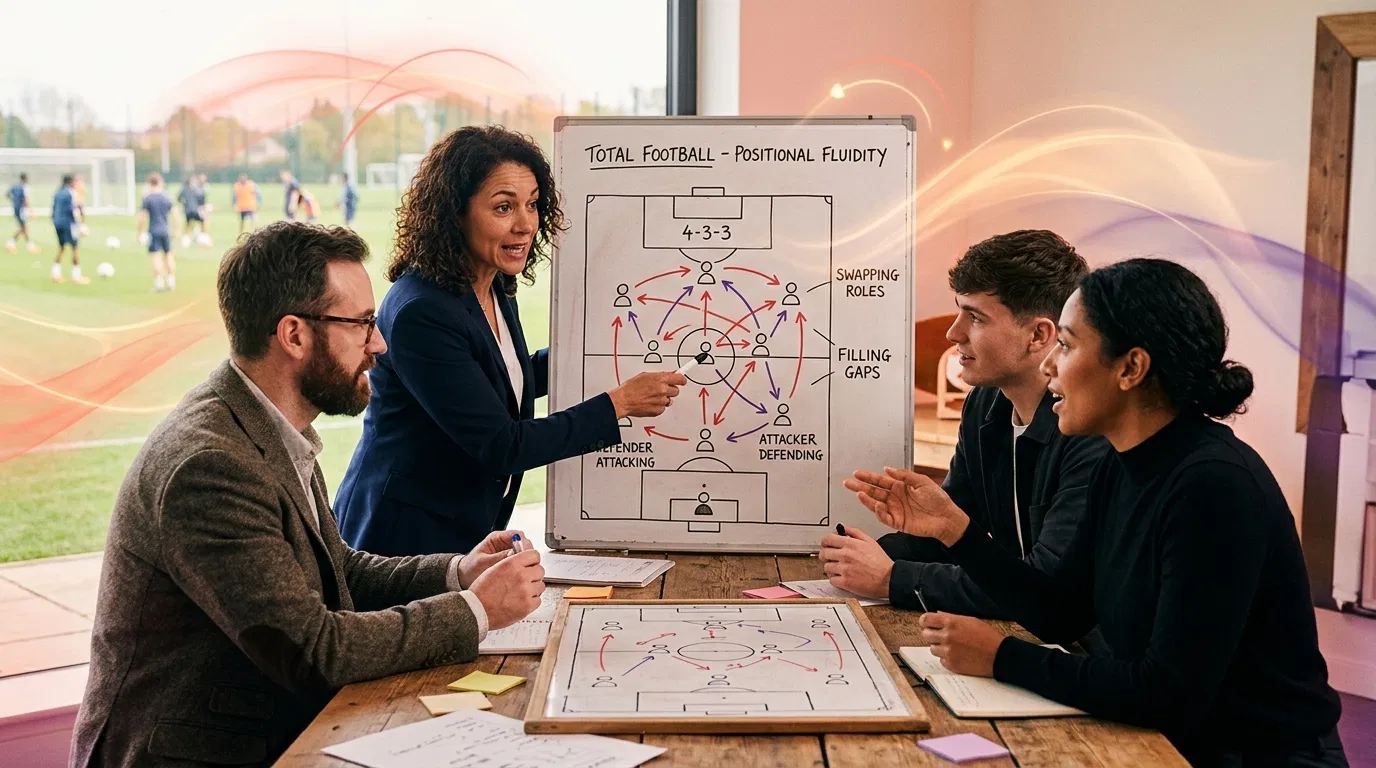
“Stop playing positions.”
That was the instruction Rinus Michels gave his Ajax Amsterdam players in the late 1960s, and it scandalized the football establishment. His system became known as total football.
Any outfield player could take over the role of any other player on the pitch. Defenders attacked. Midfielders defended. When someone moved out of position, a teammate filled the gap, and the team's shape held even as every individual within it was fluid.
Critics called it reckless. Undisciplined. A system that would collapse the moment it faced a team that actually knew its roles. What Michels required was something the old model never asked for. Every player had to be competent across the pitch. Not elite at every position, but competent enough to play any of them when the game demanded it.
The Netherlands lost the 1974 World Cup final playing total football. They lost the game and won the argument. FIFA named Michels Coach of the Century. Every serious team in the world now expects positional flexibility from its players.
Product design is having its total football moment.
The Fifteen-Year Question
"Should designers code?" has been argued for at least fifteen years. Jared Spool flagged it in 2011 as the question guaranteed to split any room of designers. Alan Cooper argued definitively no, calling it foolish and wasteful to make specialists work outside their skill. Brad Frost reframed it, arguing that designers don't need to write production code but do need to understand the grain of the medium.
The debate never resolved because it was asking the wrong question. "Should designers code?" treats coding as a binary. The real question was always about proximity. How close to the material does a designer need to be to shape it well?
AI didn't answer the old question. It made it irrelevant. The distance between design intent and working software collapsed.
What matters now is what happens to designers who can't work with the material their designs are built from.
The Shift
In March 2025, Duolingo renamed its UX function to Product Experience. The name change was a signal, not a revolution. But it pointed at something the industry was already feeling.
Nielsen Norman Group's State of UX in 2026 report was direct about it. "Many organizations will ask more of each role, compressing responsibilities that were once spread across multiple specialists." Their companion piece on "The Return of the UX Generalist" made the shift explicit. A decade of hyper-specialization was reversing, driven largely by AI tools that let individuals accomplish what previously required multiple specialists.
Figma's Shifting Roles Report put numbers on it. 64% of product team members now identify with two or more roles. People performed 17.5% more tasks per project than the year before, and 72% cited AI tools as the primary driver.
I've watched this play out in my own teams. Three years ago, a feature request moved through four handoffs before anything got built. Research, UX, visual design, engineering. Now I'm seeing designers spin up working prototypes before the research summary is even formatted. The handoffs didn't get faster. Some of them disappeared.
The fixed positions are moving.
The Specialist Trap
Between 2014 and 2022, design went through a period of aggressive specialization. UX researcher. Visual designer. Interaction designer. Motion designer. Content designer. Each role had its own career ladder, its own conferences, its own body of orthodoxy.
That structure made sense when execution was expensive. High-fidelity mockups took days. Prototypes required engineering support. Research demanded trained methodologists. Specialization was efficient because each medium required deep, hard-won craft.
Then AI collapsed the cost of execution. When execution gets cheap, the value of doing one thing at expert level competes against the value of doing four things at 80% with AI assistance. I'd call this the Specialist Trap. The hyper-specialization that was adaptive in one era becomes a liability in the next.
The data bears this out. Figma's AI Report shows that 59% of developers use AI for core work, while only 31% of designers use AI for core design tasks. The designers who aren't adapting are the most exposed to the compression. Microsoft's Work Trend Index found that 71% of business leaders would hire a less-experienced candidate with AI skills over a more experienced one without.
The market is making a judgment about value, not craft.
The Resistance (From Both Sides)
The resistance to role expansion comes from two directions at once.
Designers push back on coding. Cooper's argument is the clearest version. Specialists are rare, and making them work outside their skill is wasteful. The concern is real. Design thinking and engineering thinking use different cognitive modes. Asking someone to do both risks mediocre versions of each.
Developers push back on designers producing code. Researchers studying AI coding in 2025 found that professional developers "retain their agency in software design and implementation out of insistence on fundamental software quality attributes." When non-engineers start generating code, engineers see a threat to standards they've spent careers building.
Both sides are protecting something legitimate. Craft matters. Quality matters.
But the argument assumes a stable game. It assumes the cost structure and tooling that made specialization efficient will persist.
The strongest version of this pushback is the mediocrity objection. If everyone does everything, doesn't everyone become mediocre at everything?
Total football actually answers this. Michels didn't ask his defenders to become elite strikers. He asked them to be competent enough to play forward when the game demanded it. Johan Cruyff, the player who embodied the system, was still primarily a forward. His genius was tactical fluidity, not the elimination of specialization. The best total football players had a home position and the range to play others.
The game changed. The positions didn't disappear. What disappeared was the assumption that one position was all a player could be.
Design Engineering
Vercel, Stripe, Linear, Cursor, Replit. All of them hire for a role that barely had a name ten years ago, the design engineer. Maggie Appleton defines it as someone who "sits squarely at the intersection of design and engineering, and works to bridge the gap between them."
I've been working at this intersection for most of my career. Design intent expressed in working code, not handed off in a PDF. The conversations with engineers are different when you understand the material. The conversations with stakeholders are different when you can show them a working prototype instead of a slide deck. The decisions are different when you feel the constraints of the medium while you're making them, instead of discovering those constraints six weeks later in a QA ticket.
People have been working this way for decades. AI didn't create the role. What changed is that AI made the intersection accessible to more people and created enough market demand to give it a name.
The products being built now need people who understand the experience and the implementation. What should exist. How it behaves. How it breaks. Figma's AI Report found that 52% of people building AI products said design is more critical than for traditional products, not less. The companies building the most demanding products are hiring for breadth.
The Fluid Player
The fixed positions in design aren't disappearing. Visual craft, research, and engineering all still matter. But the walls between them turned into gradients. The designer who can prototype in code, synthesize research, and think in systems plays a different game on the same field.
The specialist who refuses to cross a boundary doesn't fail because their craft is wrong. They disappear because the game stopped making room for someone who can only play one position.
That's the bet the industry is making now. Not on generalists who know nothing deeply. On fluid players who know one thing deeply and can do three others well enough to stay on the field.